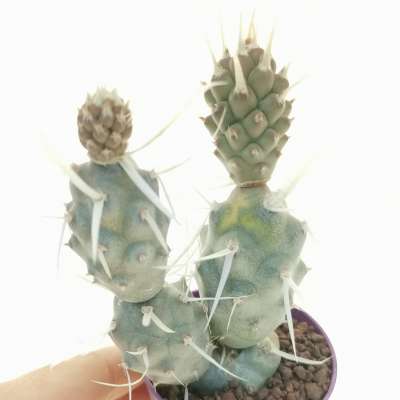
Tephrocactus articulatus var. papyracanthus f. variegata
70%
OFF
OFF




70.00€ 21.00€
Art. 54753
Available: 0
Size:
Pot: 6,5 cm.
Family:
Cactaceae
Origin:
Argentina
Secure payments

Share it
Share it
Description:
T. articulatus is a cactus specimen that is very easy to grow because it resists very well to temperature changes, at the same time requiring very simple treatments. The name comes from the Greek and means "ash", in reference to its usual color tending to greyish, but probably also for the spontaneous growth of several species on the ashes of volcanoes. The variegated shape of this cactus has clearer areas at the exact points where the chlorophyll is absent; such areas are never the same from one plant to another, therefore each specimen is absolutely unique, never identical to another and for this extremely sought after by collectors! The stem has a globose or slightly elongated shape, tuberculate and with large white and woolly areoles. From the latter come out at times flattened and soft spines, of white colour and very long, equipped with a deeply bristly tip. The flowering period is spring: its beautiful flowers bloom at the apex of the plant and are very delicate with their shades ranging from white to yellowish.
Shipping Info:
Shipping costs in Italy € 10.00 (islands € 13.00).Free shipping for orders over € 90.00.
We need 2-3 business days to prepare your plants. As soon as we have shipped your order, you will receive an email with the data to track the shipment. Delivery times with express courier are 24/48 hours, for the islands - an extra day is expected.
Find out more...
We need 2-3 business days to prepare your plants. As soon as we have shipped your order, you will receive an email with the data to track the shipment. Delivery times with express courier are 24/48 hours, for the islands - an extra day is expected.
Find out more...
Plant care:

It likes an exposure to full sun in rather airy locations.

It is preferable to keep it at mild temperatures and never below 5 °C, for this reason it is recommended to shelter it during the winter period.

Water moderately, only when the soil is completely dry. It is enough to water the plant once a week in spring and summer, once a month in autumn and to suspend watering completely in winter.

The best option is a well-draining and porous soil, even better if further enriched with 50% of inert materials such as pumice or lapilli.

They do not need frequent fertilization, it is sufficient to dilute the fertilizer with watering once a year.
Click for info