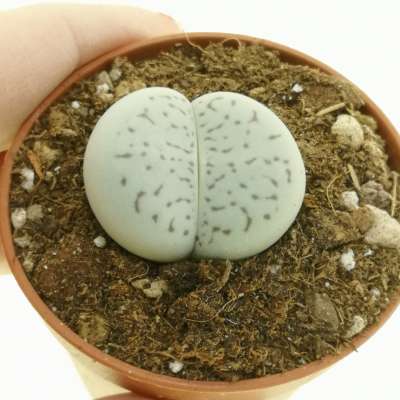
Dinteranthus vanzylii




4.00€
Art. 49567
Available: 59
Size:
Pot: 5,5 cm.
Family:
Aizoaceae
Origin:
South Africa
Secure payments

Description:
Its a succulent plant that is undoubtedly considered very interesting due to its resemblance to a rock, which is why, as well as the genus Lithops, it is commonly known as "living stone". The main difference with Lithops is that, unlike them, this species does not have a real dormancy period. Dinteranthus vanzylii consists of a single pair of compact leaves, 2 or 3 cm high, extremely fleshy that take the shape of an inverted cone. The surface is flat, of a typical chalky white color with brownish three-dimensional spots and streaks. The two leaves are separated from each other only by a thin slit, from which large solitary flowers of a beautiful bright yellow will blossom. A peculiarity: each species of these "living stones" is found in the wild exclusively near certain specific types of rocks with which they blend perfectly and, thanks to this stratagem, they try to hide and camouflage themselves so as not to be eaten by animals.
Shipping Info:
Shipping costs in Italy € 10.00 (islands € 13.00).Free shipping for orders over € 90.00.
We need 2-3 business days to prepare your plants. As soon as we have shipped your order, you will receive an email with the data to track the shipment. Delivery times with express courier are 24/48 hours, for the islands - an extra day is expected.
Find out more...
We need 2-3 business days to prepare your plants. As soon as we have shipped your order, you will receive an email with the data to track the shipment. Delivery times with express courier are 24/48 hours, for the islands - an extra day is expected.
Find out more...
Plant care:

It needs to be putted in a bright spot: it needs the maximum amount of light possible.

Keep it at temperatures above 5ºC. To stay safe, shelter it during the Winter, keeping it completely dry.

Water it regularly all over the year: once a week is ok, always waiting anyway for the soil to dry up completely. During Winter, keep the plant completely dry until it looses its old leaves (this happens in March-April). Pay attention to root rot.

Choose a well-drained substrate, possibly with an abundant mineral part, a high degree of grit, coarse sand, and pebbles.

They do not need frequent fertilization, it is sufficient to dilute the fertilizer with watering once a year.
Click for info