Find us in Loc. Venella – Terontola (AR), Italy
Call us +39(0)575.67380
Shipping all over the world

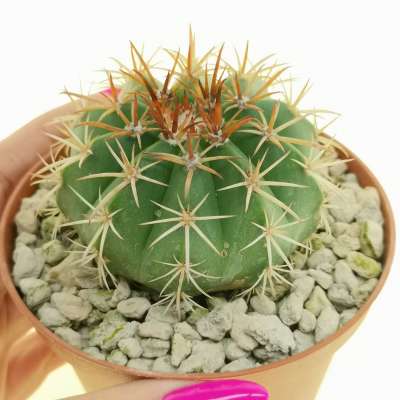
Melocactus

Melocactus albicephalus
Pot: 5,5 cm.
Art. 61838
Shop Now – 4.00€
Melocactus azureus
Melocactus azureus
Pot: 16 cm.
Art. 31745
Shop Now – 18.00€
Melocactus azureus
Melocactus azureus
Pot: 16 cm.
Art. 34575
Shop Now – 16.00€
Melocactus azureus
Melocactus azureus
Pot: 16 cm.
Art. 43150
Shop Now – 16.00€
Melocactus azureus
Melocactus azureus
Pot: 10 cm.
Art. 48788
Shop Now – 10.00€
Melocactus azureus
Melocactus azureus
Pot: 20 cm.
Art. 57860
Shop Now – 25.00€
Melocactus diersianus
Pot: 14 cm.
Art. 36125
Shop Now – 12.00€
Melocactus florschuetzianus
Pot: 7,5 cm.
Art. 58791
Shop Now – 6.40€
Melocactus matanzanus
Pot: 7,5 cm.
Art. 28280
Shop Now – 6.00€ 4.80€
Melocactus matanzanus
Pot: 10 cm.
Art. 43086
Shop Now – 8.20€
Melocactus matanzanus
Pot: 10 cm.
Art. 43133
Shop Now – 10.00€
Melocactus matanzanus
Pot: 20 cm.
Art. 55713
Shop Now – 30.00€
Melocactus neryi
Melocactus neryi
Pot: 20 cm.
Art. 49805
Shop Now – 35.00€
Melocactus schatzlii
Pot: 5,5 cm.
Art. 57987
Shop Now – 4.00€
Melocactus

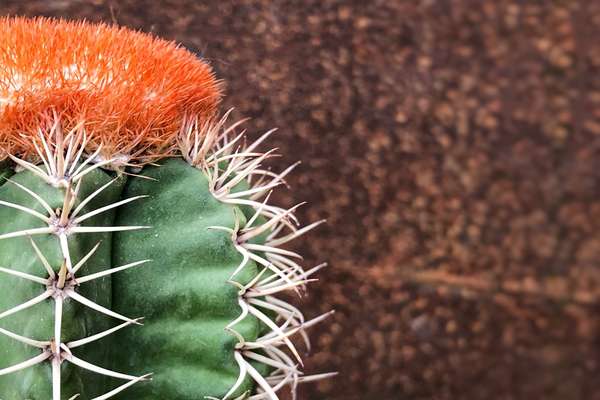
Its name consists of the Latin suffix “melo”, to identify a cactus in the shape of an apple or melon. In fact, one of its peculiarities is an accurately spherical shape, combined with the beautiful cephalium: it is a particular hairy protuberance, usually reddish, which appears on the apex, when the plant is quite mature, from which flowers bloom. From this eye-catching moment, the cactus body stops growing in size, leaving space for the columnar cephalic growth, almost as if a small red cactus grew right on top of the Melocactus! It is a very particular view, which makes this genus easily recognizable and unique, highly appreciated despite its slow growth. A curious fact: the Melocactus have existed from the ancient times. Some documents demonstrate, that they were among the first "new" plants, sighted by Christopher Columbus, when he arrived in America!