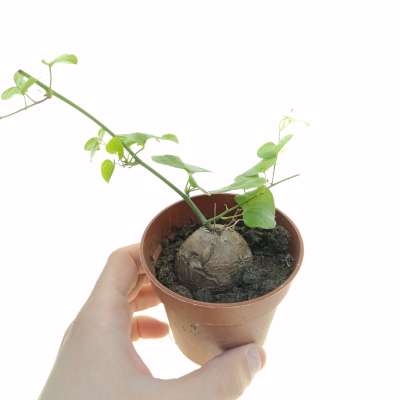
Testudinaria (dioscorea) elephantipes
20%
OFF
OFF




12.00€ 9.60€
Art. 49224
Available: 13
Size:
Pot: 8,5 cm.
Family:
Dioscoreaceae
Origin:
African tropical belt
Secure payments

Share it
Share it
Description:
Its name comes from the Latin word "tartaruga" meaning “turtle” and it makes reference to one of the characteristics for which this unusual succulent is most loved: its massive and imposing caudex (sometimes it reaches a circumference reaching up to three meters!). As it grows, it tends to form a thick bark, which splits creating deep polygonal shapes geometrically accurate, very similar to the carapace of a turtle.It is a plant that, unusually, enters the vegetative period in winter, when thin branches emerge from the woody tuber falling into a wonderful cascade of heart-shaped leaves. During the vegetative rest, however, only the caudex remains, which contains multiple nutrients sufficient for the sustenance of the plant and not only: deeply rich in starch, it is in fact also used for food purposes among the African indigenous populations, hence the common name of "bread of the Hottentots". It is not over yet, recently they discovered more uses for this decorative and particular plant, as an important herbal aid to treat numerous ailments: from the intestinal ones to rheumatism!
Shipping Info:
Shipping costs in Italy € 10.00 (islands € 13.00).Free shipping for orders over € 90.00.
We need 2-3 business days to prepare your plants. As soon as we have shipped your order, you will receive an email with the data to track the shipment. Delivery times with express courier are 24/48 hours, for the islands - an extra day is expected.
Find out more...
We need 2-3 business days to prepare your plants. As soon as we have shipped your order, you will receive an email with the data to track the shipment. Delivery times with express courier are 24/48 hours, for the islands - an extra day is expected.
Find out more...
Plant care:

It likes very bright places, however, avoid direct sunlight during the hottest hours of the day.

It is preferable to keep it at mild temperatures and never below 5 °C, for this reason it is recommended to shelter it during the winter period.

Water moderately in autumn, but only when the soil is completely dry. Water it once a month in winter and suspend watering completely in spring and summer.

The best option is a well-draining and porous soil, even better if further enriched with 50% of inert materials such as pumice or lapilli.

They do not need frequent fertilization, it is sufficient to dilute the fertilizer with watering once a year.
Click for info