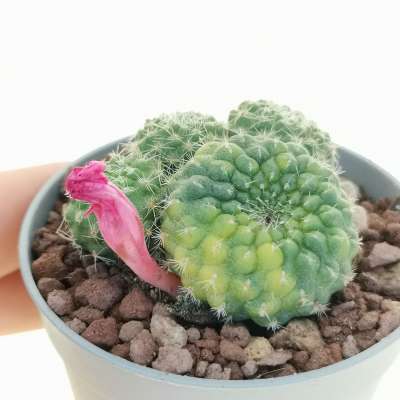
Rebutia minuscula var. violaciflora f. variegata




16.00€
Art. 56940
Available: 0
Size:
Pot: 6,5 cm.
Family:
Cactaceae
Origin:
Argentina
Secure payments

Share it
Share it
Description:
The variegated shape of this cactaceae presents the typical yellow zones in the exact points where the chlorophyll is absent; such zones will never be identical from one plant to another, thus making each exemplar absolutely unique and, for this reason, very sought after by collectors. Its stem is globose, slightly depressed at the apex, and tends, with the growth, to light abundantly creating a thick cushion of multiple suckers not exceeding a few centimeters of diameter. Equipped with numerous little pronounced tubercles, it has small areoles, from which come out short tufts of extremely thin thorns, from the shades varying from the almost vitreous white (especially in specimens with reduced illumination) up to the intense yellow ( when the solar radiation is massive). In spring R. minuscula produces pretty and abundant flowers around the base on the notes of fuchsia or red.
Shipping Info:
Shipping costs in Italy € 10.00 (islands € 13.00).Free shipping for orders over € 90.00.
We need 2-3 business days to prepare your plants. As soon as we have shipped your order, you will receive an email with the data to track the shipment. Delivery times with express courier are 24/48 hours, for the islands - an extra day is expected.
Find out more...
We need 2-3 business days to prepare your plants. As soon as we have shipped your order, you will receive an email with the data to track the shipment. Delivery times with express courier are 24/48 hours, for the islands - an extra day is expected.
Find out more...
Plant care:

It requires a lot of light during all seasons, however avoid direct sun rays during the hottest hours of the day, as they could cause burns.

It prefers rather mild temperatures, yet it is very resistant. However, it is preferable to keep it at temperatures above 0 °C.

Water moderately, only when the soil is completely dry. It is enough to water the plant once a week in spring and summer, once a month in autumn and to suspend watering completely in winter.

A soil suitable for cacti is an optimal solution, even better if it is further mixed with 50% of pumice or lapilli.

They do not need frequent fertilization, it is sufficient to dilute the fertilizer with watering once a year.