Melocactus perezassoi




10.00€
Art. 50598
Available: 0
Size:
Pot: 10 cm.
Family:
Cactaceae
Origin:
Cuba
Secure payments

Share it
Share it
Description:
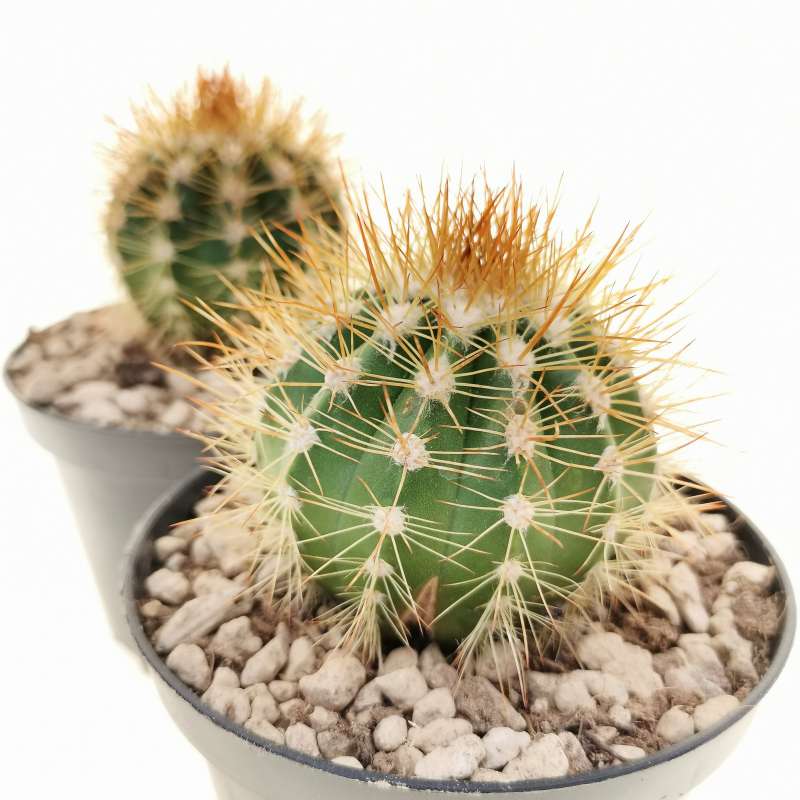
The name of this peculiar cactaceae was chosen in honor of A. Pérez Asso, who first discovered the species along steep rocky walls. It is a globose cactus not exceeding about 15 cm in diameter, equipped with deep longitudinal ribs along which large white and woolly areoles are arranged in a row. From the latter come out numerous yellowish radial spines, thin and needle-like, rather long and arranged radially around the areola and more robust central spines slightly curved upwards, which assume shades from yellow to orange. The overall appearance is that of a strongly wild plant due to the multitude of bristly and long spines that wrap it and create a wonderful contrast between their yellow-orange and the soft and opaque green of the stem. However, the most striking part of this cactaceae remains, without any doubt, the majestic cephalium which develops at the apex with thick salmon-coloured bristles, in the middle of which, between spring and summer, pretty flowers on the delicate shades of rose will bloom to beautify your locations!
Shipping Info:
Shipping costs in Italy € 10.00 (islands € 13.00).Free shipping for orders over € 90.00.
We need 2-3 business days to prepare your plants. As soon as we have shipped your order, you will receive an email with the data to track the shipment. Delivery times with express courier are 24/48 hours, for the islands - an extra day is expected.
Find out more...
We need 2-3 business days to prepare your plants. As soon as we have shipped your order, you will receive an email with the data to track the shipment. Delivery times with express courier are 24/48 hours, for the islands - an extra day is expected.
Find out more...
Plant care:

It likes an exposure to full sun in rather airy locations. Fare attenzione a bruschi sbalzi di Temperature.

It is preferable to keep it at mild temperatures and never below 10 °C, for this reason it is recommended to shelter it during the winter period.

In spring-summer, water moderately but only when the soil is completely dry, and suspend watering completely during autumn-winter.

A well-draining and porous soil is an optimal solution, even better if further enriched with 70% of inert materials such as pumice, sand or lapilli.

They do not need frequent fertilization, it is sufficient to dilute the fertilizer with watering once a year.