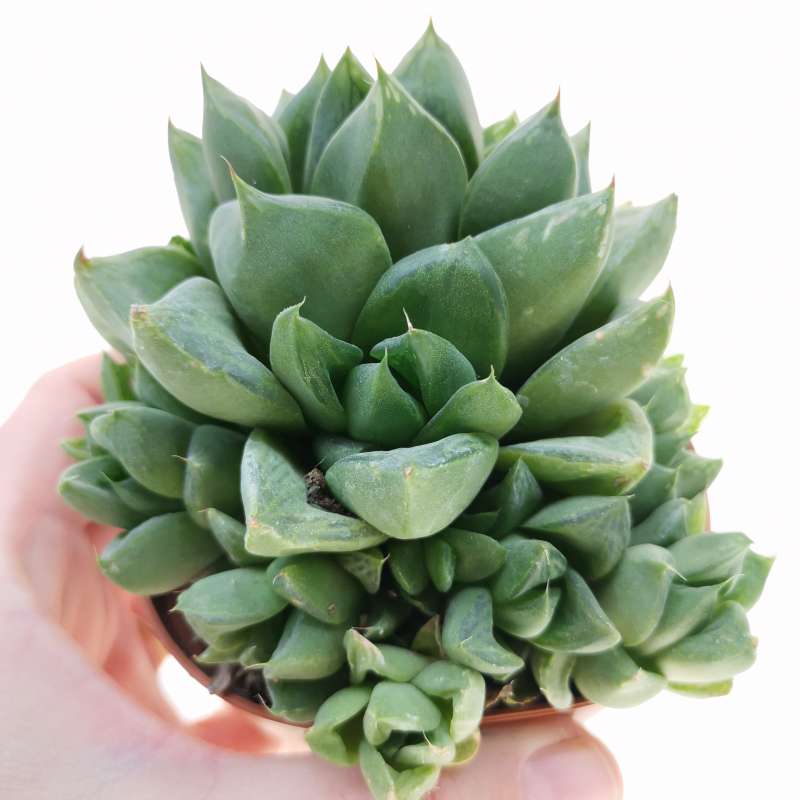
Haworthia cuspidata


6.00€
Art. 40951
Available: 0
Size:
Pot: 10 cm.
Family:
Aloaceae
Origin:
Cultivar
Secure payments

Share it
Share it
Description:
This succulent is considered a cross between the Haworthia retusa and Haworthia cymbiformis species. It is one of the most elegant species of the genus, characterized by graceful rosettes with fleshy foliage of a lively lime green color, very bright, enriched by small translucent areas, that make the light pass trough, and allow the plant to survive very well, even in conditions of low light (hence the common name of "star window plant"), making it a succulent particularly suitable for indoor environments. The small leaves have the shape of a wedge - a characteristic that gave them the name of 'cuspidata', from Latin - "pointed". It is a strong and resistant plant, which occupies little space and does not present difficulties in cultivation. Perhaps not many know, that the leaves inside them are full of aloe juice, commonly used to treat skin irritations, as well as, in alternative medicine - even for various other ailments: from fever to ulcers!
Shipping Info:
Shipping costs in Italy € 10.00 (islands € 13.00).Free shipping for orders over € 90.00.
We need 2-3 business days to prepare your plants. As soon as we have shipped your order, you will receive an email with the data to track the shipment. Delivery times with express courier are 24/48 hours, for the islands - an extra day is expected.
Find out more...
We need 2-3 business days to prepare your plants. As soon as we have shipped your order, you will receive an email with the data to track the shipment. Delivery times with express courier are 24/48 hours, for the islands - an extra day is expected.
Find out more...
Plant care:

Requires an exposure in partial shade, as long as it still receives plenty of light throughout the year.

It is preferable to keep it at mild temperatures and never below 5 °C, for this reason it is recommended to shelter it during the winter period.

It is advisable to always keep the soil slightly moist in spring and summer. Beware of stagnant water that could cause rotting.

The best soil is a well draining one, for example formed by a mixture of peat and pumice so that the water does not stagnate.

They do not need frequent fertilization, it is sufficient to dilute the fertilizer with watering once a year.
Click for info